After The Session: Acoustic Physics, Resonance and the Vocal Tract!
Thursday 27th August 2026
Voice Study Centre
Acoustic Physics & Resonance: Expanding on Dr. Brad Story’s Presentation
From 3D Imaging to Tubular Models: Dr. Story started the session by demonstrating how modern imaging techniques (MRI and low dose X-ray CT) allow researchers to segment the 3D airspace of the vocal tract. This complex geometry is simplified into 1D area functions and "tubular models" - such as his computational model, TubeTalker - to simulate acoustic wave propagation.
To help unpack the session's foundational physics, let's explore the fundamental principles of standing waves, frequency domains, and acoustic sensitivity that Dr. Story covered...
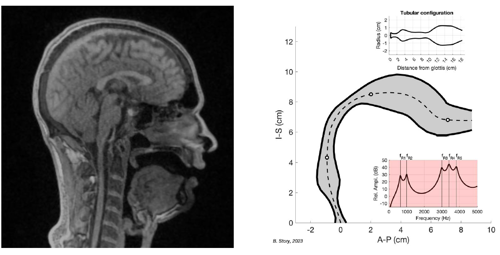
- The Source-Filter Model in the Time vs. Frequency Domain
To model human sound production, acoustic scientists separate the system into a source (the vibrating vocal folds) and a filter (the vocal tract airspace).
- Time Domain: Signals exist as pressure and flow waves moving over time. At the larynx, the vocal folds produce a periodic pulse train of glottal airflow.
- Frequency Domain: The glottal airflow pulse train transforms into a spectrum featuring a fundamental frequency (F0) and integer multiples called harmonics.
- Harmonic Richness: A pure sinusoidal flow wave contains no harmonics and passes through the vocal tract unchanged. Human vocal quality relies on glottal flow features like skewing (the wave leaning to the right) and an open/closed quotient (a period where the glottis fully closes). These features generate the rich harmonic energy needed for the vocal tract to shape.
- Standing Waves and Vocal Tract Resonances
When glottal airflow enters the vocal tract, acoustic waves travel forward toward the lips and reflect back toward the larynx.
- Wave Superposition & Interference: When two traveling waves of equal frequency and amplitude move in opposite directions, their pressures combine through constructive and destructive interference. This interaction creates a standing wave - a wave pattern that oscillates in magnitude but remains stationary in space.
- Nodes and Resonances: Standing waves establish nodes (points where acoustic pressure remains at zero) and antinodes (points of maximum pressure variation). The natural frequencies at which the vocal tract can sustain these standing wave patterns are its resonances (fR1,fR2 and fR3)
- Filter Action: Frequencies matching the vocal tract’s resonances pass through efficiently and emerge in the output spectrum as prominent energy peaks called formants (F1,F2,F3). Off-resonance frequencies cannot set up standing waves; they hit an acoustic barrier and become attenuated (suppressed).
- Energy Reflection at the Lips: Interestingly, roughly 99% of the acoustic energy reaching the lips is reflected back into the vocal tract. While this sounds inefficient, this high degree of reflection is necessary to sustain standing waves, allowing us to form distinct vowels and consonants.
- Acoustic Sensitivity: How Vocal Tract Shapes Change Pitch Resonances
Rather than calculating complex wave equations on the fly, singers intuitively manipulate vocal tract geometry to alter standing wave energy. Dr. Story models this using Acoustic Sensitivity Functions, which map kinetic and potential energy within standing waves across the length of the vocal tract:
- Constrictions vs. Expansions: Constricting a region high in potential energy (a pressure antinode) raises that specific resonance frequency, whereas constricting near a node lowers it. Conversely, expanding those same regions produces the opposite shift.
- Predictable Rules: For instance, constricting at the lips lowers all formant frequencies across the board. Constricting the anterior oral cavity while expanding the pharynx moves F1 down and F2 up, producing an /i/ ("ee") vowel shape.
- Vowel Modification & Tuning: Singers leverage these sensitivity relationships to solve acoustic challenges. High-pitched sopranos modify vowel shapes (such as opening the mouth on high notes) to keep positioned just above F0, preserving vocal resonance and tone quality.
Clustering and Converging: Advanced Vocal Techniques
These core physical principles explain complex vocal strategies:
- Singer's Formant Cluster: By creating a tight constriction in the epilarynx and expanding the lower pharynx (achieving at least a 6:1 cross-sectional area ratio), singers cluster upper resonances (F3, F4, and F5) around 3,000 Hz. This produces a concentrated boost of high-frequency energy that carries over a full orchestra.
- Overtone/Polyphonic Singing: By bringing F2 and F3 together into a single "super resonance," singers like Anna Maria Höfele isolate single high harmonics (from the 10th down to the 4th). Moving this merged resonance back and forth along the frequency axis allows the singer to perform a distinct overtone melody over a steady fundamental drone.
Recommended Resources & Further Reading
For those looking to dive deeper into the topics discussed, Dr. Story recommended the following resources:
- YouTube Channel: Search for Speech Acoustics on YouTube to view video demonstrations of the acoustic models shown in the presentation.
- Contact: Reach Dr. Story via email at bstory@arizona.edu.
- Books & Chapters:
- Ingo Titze’s Principles of Voice Production.
- Foundations of Speech and Hearing (2nd Edition, Jan 2026) by Jenny Hoit, Gary Weismer, Brad Story, and Rosemary Lester.
- Book chapter: "The Vocal Tract in Singing" in the Handbook of Singing (available via Dr. Story's website or ResearchGate).
Thank you to everyone who attended live! The full recording is now available on catch-up for registered participants.
Recent Posts

After The Session
After The Session: Inspired Not Bound: The Promise of Science-Informed Voice Pedagogy
Voice Study Centre
Wednesday 7th October 2026Yesterday, Voice Study Centre hosted Lynn Helding, Professor of Practice in Vocal Arts and Opera and Coordinator of Vocology and Voice Pedagogy at the USC Thornton School of Music. Her presentation was a compelling exploration into the relationship between voice science and vocal art. Titled "Inspired Not Bound: The Promise of Science-Informed Voice Pedagogy," the session tackled a question that has lingered for over 170 years: If voice science is so rich and transformative, why hasn't it been more fully adopted across all voice studios?
Read More...
Student & Alumni News
Alumna Brunella Govetto Writes for Inspire the Mind on Singing and Motherhood
Voice Study Centre
Monday 28th September 2026Voice Study Centre alumna Brunella Govetto has written a new article for the Inspire the Mind blog, drawing on her thesis work and experience of working with singing and mothers.
Read More...
After The Session
After The Session: Doubles and Stacks, Reverbs and Effects: Teaching Vocal Production Skills
Voice Study Centre
Wednesday 23rd September 2026For many vocalists and voice teachers, the world of digital audio workstations (DAWs), hardware, and studio processing can feel like forbidden territory. Yesterday, Voice Study Centre hosted a hands-on, practical short course led by Kelly Hoppenjans (voice teacher, and PhD candidate in musicology at the University of Michigan), designed specifically to break down these technological barriers and empower singers to approach vocal production creatively, playfully, and confidently - so what did we learn?
Read More...