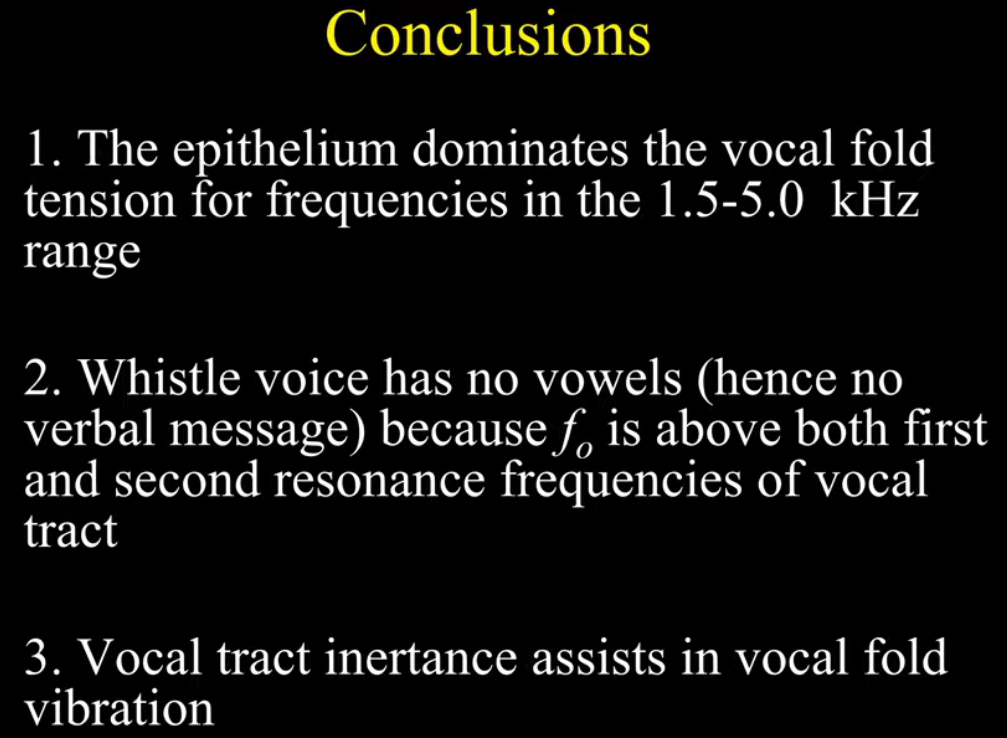
After The Session: The Acoustics and Mechanics of Whistle Voice - what did we learn?
Monday 13th April 2026
Voice Study Centre
Educated as a physicist (Ph.D.) and engineer (M.S.E.E.), Dr Ingo Titze has applied his scientific knowledge to a lifelong love of clinical voice and vocal music. He has written over 500 publications and six books in voice production.
Before diving into the whistle register specifically, Titze defined a "voice register" as a plateau of vocal timbre (voice quality), As a singer changes their pitch, loudness, or vowel, the voice quality remains relatively stable until it hits a transition point. Crucially, "registration" is not just about the larynx; it involves the entire airway, the whole musical instrument of the human body.
The whistle register is the highest register of the human voice, sitting above the falsetto. Titze explored the biomechanical and acoustic variables that allow for these extreme frequencies:
- Vocal Fold Vibration: Unlike lower registers where the vocal folds vibrate in their entirety, the whistle register involves a specific type of vibration where only a small portion of the folds may be active.
- Acoustic Transitions: Titze illustrated how the voice moves between registers using a "step-function" model. As a physiologic or acoustic variable changes, the voice stays in "Register 1" until it reaches a transition zone, where it then shifts into "Register 2" (such as the whistle register).
- The "Whistle" Effect: The acoustics of this register are unique because the sound is produced similarly to how air moving through a small opening creates a whistle, often bypassing some of the heavier muscular involvement found in chest or head voice.
Why does this matter? Understanding the biomechanics of the whistle register isn't just for scientists; it’s vital for:
- Vocal Health: Knowing how the folds transition helps singers avoid "breaking" or straining their voices.
- Training: Teachers can use these acoustic principles to help students navigate the transition into their highest range more smoothly.
- Performance: Gaining control over these plateaus allows for consistent voice quality across a wide range of notes.
The human voice is a marvel of biological engineering. By studying the whistle register, we gain a better appreciation for the precision required to produce the sounds that define some of the most iconic moments in music.
Voice Study Centre hosts guest presenters and speakers from all over the world, all experts in their field. There is at least one short course per week; please browse our full lineup for the coming weeks. Our schedule is always changing, so check back regularly! Sign up to our mailing list for all the latest offerings..
Recent Posts
Student Interviews
Negotiating Authenticity: Tre Cooper Explores Cross-Genre Singing and Stylistic Decision-Making
Voice Study Centre
Friday 23rd October 2026What does it mean for a singer to sound authentic when performing in a genre outside their usual style? And how can voice teachers help singers develop stylistic versatility without losing their individual artistic identity?
Read More...
After The Session
After The Session: Practical Magic*: The Art & Science of Balancing Voices with SOVTs and VFEs with Melanie Tapson
Voice Study Centre
Thursday 22nd October 2026What makes a vocal exercise effective? Is it the tool itself, the way we use it, or our understanding of what happens when we put it into practice? In Practical Magic: The Art & Science of Balancing Voices with SOVTs and VFEs, voice teacher and professional singer Melanie Tapson explored the science behind two widely used approaches to voice training: Semi-Occluded Vocal Tract Exercises (SOVTs) and Vocal Function Exercises (VFEs). Combining scientific explanations with practical demonstrations and interactive activities, the session examined how these techniques can support vocal efficiency, stamina and sustainable voice use. Rather than treating exercises as a one-size-fits-all solution, Melanie encouraged participants to understand what each exercise does, how individual voices respond and how to adapt techniques to achieve meaningful results.
Read More...
After The Session
After The Session: Introduction to Vocal Acoustics for Spoken and Sung Voice with Gökçe Kutsal
Voice Study Centre
Wednesday 21st October 2026How can understanding the science of sound help us become more effective voice teachers, singers and researchers? In our recent two-part course, Introduction to Vocal Acoustics for Spoken and Sung Voice, Gökçe Kutsal explored the fascinating relationship between the physics of sound and the way we produce, hear and understand the human voice.
Read More...