How Olivia Sparkhall Built an Award-Nominated Career in Vocal Health and Composition
Friday 22nd May 2026
Voice Study Centre
Olivia tailored her MA studies around three distinct, but interrelated areas of specialism. A passionate educator in both the primary and secondary sectors, Olivia was keen to delve into very best practice when working with young people’s developing voices. Her key areas of research focussed on vocal warm-ups for children, composing the very best inclusive music for young voices, and the vocal health of children and young people. She describes her Masters as “lifechanging” because it has since enabled her to pursue a freelance career as an expert in these very specific areas.
After her book, ‘A Young Person’s Guide to Vocal Health’, was a finalist in the Music and Drama Education Expo awards 2024 (Outstanding Music Education Print Resource category), the BBC Music Magazine featured Olivia in their ‘All the right notes’ podcast series.
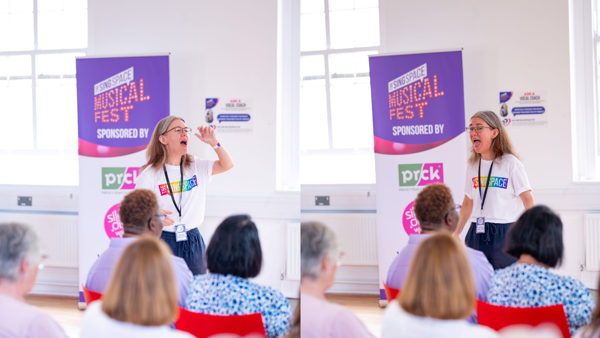
Publishing ‘A Young Person’s Guide to Vocal Health’ also led to a whole host of lecturing and workshop engagements for organisations including the Association of British Choral Directors, the Royal School of Church Music, The Professional Teaching Institute, the Independent Schools’ Curriculum Committee, as well as Voice Study Centre itself, where she has taught a five-week ITOL certificated course as well as several short courses.
An award-winning composer, Olivia now receives regular commissions for choral and organ pieces, the most recent being commissioned by the organist of Harvard University. Her works have appeared on acclaimed albums, including Welcome Joy, BBC Music Magazine’s album of the month for December 2024. In the programme notes, Frankie Perry elaborates: “Sparkhall belongs to a long tradition of choral composer-conductors – including Gustav Holst – whose practice is deeply informed by vocal pedagogy and intricate knowledge of the practicalities of upper-voice singing.”
Olivia’s expertise in a range of vocal health-related areas, used in conjunction with her pedagogical training, has meant that she is increasingly in-demand as a specialist singing teacher and voice coach, discreetly working with professional performers to overcome vocal issues. “It is a particular privilege to help singers who are struggling, and hugely rewarding to help them build healthier, more resilient voices to ensure their professional longevity.”
We are incredibly proud to have Olivia as part of the VSC alumni community and have loved following her inspiring journey since completing her MA. Thank you for continuing to be such a valued part of our thriving community, Olivia!

Olivia Sparkhall
Olivia Sparkhall is a composer, choral conductor, voice coach and music teacher based on the edge of the New Forest in Hampshire, UK. She is a Voice Study Centre (University of Wales...
Recent Posts

Student & Alumni News
One Christmas Piece to Unite Them All: A Czech Christmas Tradition

Adléta Hanžlová
Wednesday 25th November 2026MA Voice Pedagogy student Adléta Hanžlová shares her personal experiences of performing the Czech Christmas Mass and explores the much-loved festive tradition that brings singers and musicians together across the Czech Republic.
Read More...
After The Session
After The Session: A (Very) Brief Course in Linguistics! with Miranda Guettlein
Voice Study Centre
Wednesday 18th November 2026A recap of our introductory linguistics course for voice teachers, speech practitioners, actors and dialect coaches, led by Miranda Guettlein, linguist, dialect coach and editor of the Voice and Speech Review.
Read More...
After The Session
After The Session: Neurodivergence and Critical Disability Theory with Dr David Cane
Voice Study Centre
Monday 9th November 2026A recap of our session with Dr David Cane, Senior Lecturer on the Voice Study Centre MA in Voice Pedagogy, on disability and neurodivergence within the voice teaching studio. When we talk about disability and neurodivergence in voice teaching, the first thing that comes to mind is often a single question: what do I do if a disabled or neurodivergent student walks into my studio? In this session, Dr David Cane invited us to think much bigger. The teacher might be disabled or neurodivergent. So might a choir director or a colleague. The songs we teach may depict or use disability as a metaphor. Even the foundational texts of voice pedagogy carry assumptions about bodies and voices. This was a densely theoretical tour, and David was open about that. His argument was that the most important work is not a checklist of practical tips, but a rethink of what we believe teaching is for. Here are the main threads.
Read More...