Voice Study Centre Online Symposium 2025
Wednesday 26th November 2025, 5:00 PM - 9:00 PM (London Time)
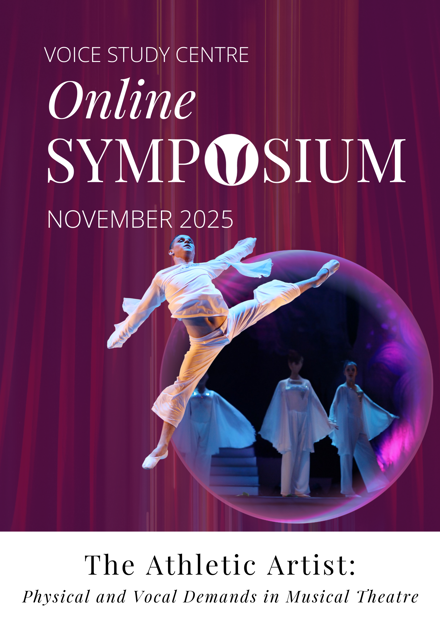
Welcome to The Athletic Artist: Physical and Vocal Demands in Musical Theatre, a symposium dedicated to bridging the gap between artistic training and athletic conditioning for performers.
Musical Theatre performers are athletes balancing the demands of singing, dancing and acting. The purpose of this symposium is to ask important questions, share research and disseminate good practice. It is an opportunity for researchers and industry experts to come together as a hive mind to stimulate further research and work collaboratively as a network.
Schedule
5:00 pm (GMT) Welcome and Introduction, followed by:
| Time | Session Title |
|---|---|
5:05 pm |
Keynote Speaker: Dr. Amanda Flynn |
5:55 pm |
Simultaneous Singing and Dancing: A Cross-Disciplinary Review with Debbie Winter |
6:05 pm |
The Additional Demands on the Musical Theatre Performer and Potential Links to Increased Laryngeal Tension: A Rapid Review with Dr Claire Thomas |
6:20 pm |
Interactive Workshop: Excavating Emotionally Engaged Performance. What is the physical and mental toll for Musical Theatre singers? With Louisa Morgan |
6:50 pm |
The Vocal Athlete: A Literature Review of Physiological Resilience to Performance Adrenaline in Professional Singers with Dan Cassin |
7:00 pm |
Cross Training and Conditioning for Musical Theatre Performers: A Theoretical Framework with Jennifer Myers |
7:10 pm |
Psychological and emotional well-being of undergraduate theatre artists in Nigerian HEIs with Abimbola Adetola Stephen-Adesina |
7:20 pm |
Singing as a triple threat: A qualitative study of professional, semi-professional, and vocational trainee performers’ experiences of singing while simultaneously performing the three musical theatre disciplines of singing, acting, and dancing with Christine Descher. |
7:30 pm |
Integrating acting through song and extreme singing techniques for sustainable performance with Kaya Herstead–Carney |
|
|
Finding Wonderland: A case study of the teacher as coach in supporting undergraduate musical theatre students in an industry-facing production of Wildhorn's Wonderland with Racheal Owens and Frances Williams |
7:50 pm |
Vocal Health Practice for Musical Theatre Students with Catherine Kimmance |
8:00 pm |
Voice as Gesture and Experience: Two Performative Paradigms in Contemporary Musical Theatre with Anca Markos |
8:10 pm |
Technique You Can See with Jeremy Ryan Mossman |
8:20 pm |
And All That Jazz: How professional musical theatre performers experience and manage vocal challenges when executing Fosse choreography, and how these insights inform more integrated and sustainable voice and movement pedagogy in training institutions: A Practice-led investigation with Cathrine Hopkins |
8:30 pm |
Round Table DiscussionExpert Panel: Mary Saunders Barton, Besfort Williams and Scott Harrison.
|





The full symposium will be recorded for catch-up at a later date if you cannot attend live.
View the full programme:
Sorry, this is an archived short course...
We have plenty of upcoming short courses coming soon. See details of some of them below or look at the full list of short courses.

Monday 19th October 2026
2:00 PM - 4:00 PM
Tuesday 20th October 2026
2:00 PM - 4:00 PM
(London Time)
Introduction to Vocal Acoustics for Spoken and Sung Voice

Gökçe Kutsal
This course is designed to break down the fundamentals of acoustics for both spoken and sung voice in a beginner-friendly, accessible way — so you can easily understand and apply these concepts to your teaching or research.
Tuesday 20th October 2026
5:00 PM - 7:00 PM
(London Time)
Practical Magic*: The Art & Science of Balancing Voices with SOVTs and VFEs

Melanie Tapson
Through live demonstrations, group practice, and peer coaching, you’ll learn how to teach SOVTs and VFEs with clarity and precision, integrate their principles to support vocal health, recovery, and stylistic flexibility and troubleshoot challenges and adapt exercises for individualized results.
Tuesday 27th October 2026
5:00 PM - 7:00 PM
(London Time)
Pop Pedagogy - an Overview

Kim Chandler
Some successful pop stars are celebrating career lengths of over sixty years, having been around since the 1950s when pop music emerged and diversified from jazz, so pop singing has been in existence sufficiently long now that, for teaching purposes, we can observe and analyse what type of approach serves it best.